
Congratulations, you’ve found your new home! But as you start planning the move, you hit a critical question — do you need a “local” or a “long-distance” mover? The miles on a map tell only part of the story. The distinction between local and long-distance moving services goes much deeper. It changes how your move is priced, which regulations apply and how long the process takes.
We’ll break down the key differences so you can choose the right service and know what to expect.
The definition of a “local move” is more nuanced than it often appears, as it actually varies significantly from state to state. For example, in Michigan, a local move is defined as under 40 miles between origin and destination and is typically charged hourly. In contrast, New York state requires local hourly rates to be submitted to a regulatory board.
Despite these state-specific variations, a local move generally refers to a relocation within the same city, metro area or state. It typically involves moving your belongings from one home to another within the same general area, whether that’s across town or to a neighboring community. The key characteristic is that everything happens within a shorter distance and usually on the same day.
Because of the shorter distance, expert local moving services can typically complete the entire process in a single trip. Your items are loaded, transported and unloaded without needing overnight storage or multiple-day transit.
A move is officially “long-distance” the moment you cross a state line. This is why long-distance moves are also called interstate moves.
Regarding short-distance versus long-distance moving, even a short move from one state to another qualifies as a long-distance relocation. For example, if you’re moving 20 miles from a city in Michigan to a suburb just across the border in Ohio, that’s technically a long-distance move. The state line is the critical factor.
Why does this matter? Crossing state lines triggers a completely different set of regulations, pricing structures and planning requirements. A professional long-distance relocation usually involves federal oversight, but some states are completely regulated while others are not.
Consumer protection and regulatory oversight change significantly depending on whether you’re making a local or long-distance move. Working with a reputable mover who understands and follows the correct regulations protects you throughout the process.
Local moves are governed by state-level agencies. Each state has its own department overseeing intrastate movers, such as:
This means the specific rules and consumer protections can vary from state to state. For instance, movers in Texas must be licensed by the Texas DMV, which sets specific requirements for valuation, contracts and business practices.
When hiring local movers, verify they hold the proper state licenses and meet your state’s regulatory requirements.
The moment your move crosses state lines, federal regulations take over. The Federal Motor Carrier Safety Administration (FMCSA) is the federal body that regulates all interstate movers.
Any moving company crossing state lines must be registered with the FMCSA and have a valid U.S. DOT number. This registration ensures they meet federal safety standards and consumer protection requirements.
By law, interstate movers must make available the “Your Rights and Responsibilities When You Move” booklet, which outlines your protections and the mover’s obligations. Through the FMCSA’s Protect Your Move initiative, you can verify any interstate mover’s registration and check their safety record.
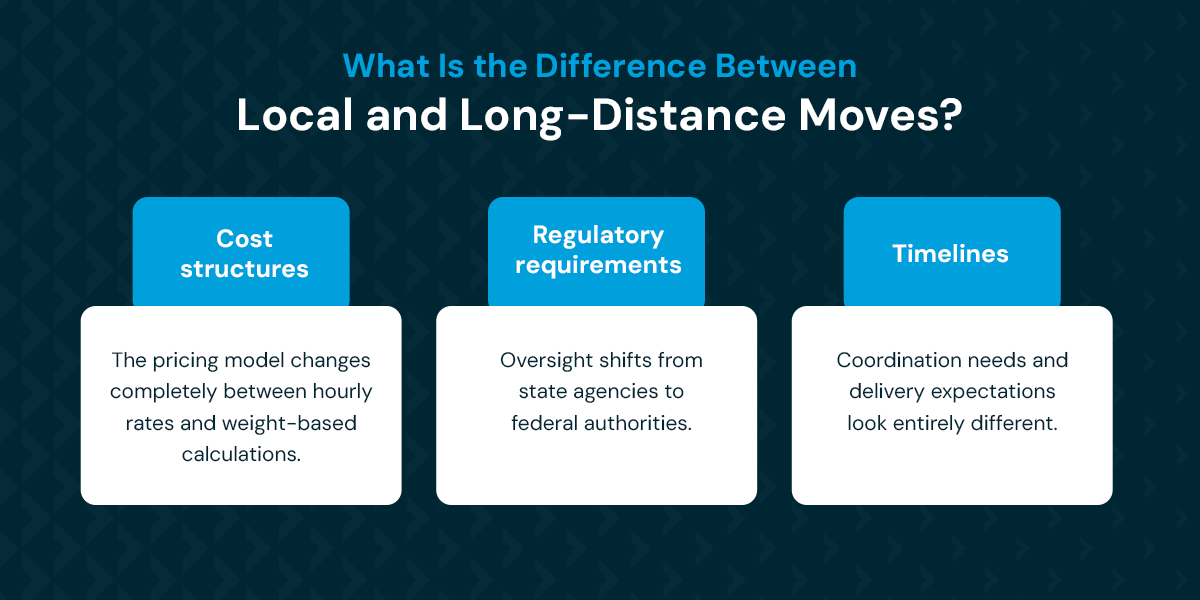
The differences go beyond the truck’s travel time. These two types of moves have different:
Understanding these differences helps you set realistic expectations and budget appropriately. Whether you’re planning a local or long-distance relocation, you can ask the right questions and choose comprehensive residential moving services that fit your needs.
One of the biggest differences between local and long-distance services is how movers calculate your final bill. The pricing model changes depending on the type of move.
Local movers generally charge by the hour. Your total cost depends on how many movers are assigned to your job and how long it takes them to complete the process from start to finish.
The hourly rate includes several components, including:
Depending on the size of your moving crew and the day of the week, the hourly rate can vary. Higher rates are common on weekends and during the peak moving season, which runs mainly from May through September.
Long-distance moves use a different pricing structure. Movers calculate your cost based on the total weight of your shipment and the distance it travels. After conducting a virtual or in-home survey of your belongings, most interstate movers provide a binding estimate. It protects you from surprise costs and gives you a clear understanding of your total investment.
Professional movers have transparent pricing structures. While a DIY move might seem more cost-effective, it can have many hidden costs that add up quickly when you handle everything on your own.
Beyond cost and regulations, local and long-distance relocations involve different moving processes. Your timeline expectations and coordination needs change based on which service you’re using.
Proper packing and unpacking services are crucial for moves of any distance, but the packing timeline can vary between local and long-distance moves. However, these are optional add-ons, not automatically included with every move.
Local moves are straightforward. With the same crew and truck handling your move from start to finish, the process typically happens in a single day or two. Smaller home moves can be completed in a day, but larger ones can take more than a day, even for local moves. From morning arrival through loading, transport and unloading at your new location, everything flows continuously.
This simplicity makes scheduling much easier. The entire process happens in a single continuous timeline, so you know exactly when your belongings will arrive. Depending on the size of your home and the distance between locations, most local moves wrap up within a few hours.
Long-distance moves involve more complex coordination. Your belongings may be loaded onto a truck that makes multiple stops to pick up other shipments before heading to its final destination. So, the crew who loads your items at your old home may not be the same crew who unloads at your new one.
Instead of a specific delivery date, interstate movers work within a delivery window. Depending on the distance, this window might be several days. Throughout the journey, your mover will provide an estimated delivery range and stay in contact with you.
A dedicated move coordinator is invaluable for long-distance relocations. They help you navigate the timeline and ensure everything stays on track. If there’s a gap between when you need to vacate your old home and when your new home is ready, professional storage solutions can bridge that timing difference.
Whether you’re relocating across town or across state lines, Corrigan Moving Systems brings nearly 100 years of experience to both local and long-distance moves. We understand the specific regulations and timelines that shape each type of relocation, and we’re here to make yours smooth and straightforward.
Ready to get started? Contact us today for a free in-home or virtual consultation. We’ll provide a clear, detailed quote tailored to your specific journey.