

Picture this — your belongings are packed, your timeline is set and you’re prepared for a smooth transition ahead. For millions of households moving each year, temporary storage bridges the gap between homes for a more manageable experience.
Whether you’re downsizing, facing a timing mismatch between lease and closing, or renovating before settling in, moving storage offers a simple solution for safety and convenience. The key is to find an option that fits your budget without sacrificing peace of mind.
Compare the most cost-effective ways to store belongings based on cost, convenience and timeline. You’ll avoid costly surprises and make the right choice with confidence, turning your move into a seamless transition to your new home.
Storage needs arise from several common scenarios, and understanding which applies to you helps narrow down the best solution. Whether you’re looking for cheap storage options during a move or a full-service approach, the most affordable way to store belongings during a move depends on your timeline and circumstances.
Some common situations that necessitate temporary storage include:
Each storage solution offers different benefits depending on your budget, how much control you want and whether you’re willing to trade convenience for cost savings.
Traditional self-storage facilities rent you a space — typically ranging from small 5×5 lockers to large 10×20 units — where you store belongings for as long as needed. You transport everything yourself and have 24/7 or limited-hours access depending on the facility.
Self-storage often offers the most affordable way to store items during a move, especially for several months. You’ll find competitive pricing and plenty of size options.
The catch is that you’re responsible for getting belongings to and from the facility. That means renting a truck, loading everything, driving it to storage, unloading and repeating the process when retrieving items.
Portable containers, such as PODS or U-Pack, get delivered to your driveway. You pack the container at your own pace, then the company picks it up and either stores it or delivers it to your new address.
The major benefit is convenience. You load and unload once, and the container comes to you. This process saves significant time and physical strain.
Portable containers typically cost more than traditional self-storage, but when you compare the all-in cost, the difference often narrows. If your move involves both storage and transportation, a container can be a smart middle-ground option.
Many newer companies offer a box-based model where you pack belongings into provided containers before they pick them up and store them in a warehouse. This setup can work well for anyone with a small apartment’s worth of belongings.
By-the-box is often the most budget-friendly option for very small moves, since you pay per box rather than paying for an entire unit you might not fully use. However, it’s not practical for furniture or large household moves.
The advertised monthly rate is just the starting point. Several variables influence what you’ll actually pay, so understanding them up front helps you budget accurately.
Volume is the primary cost driver. A 5×5 unit usually works for boxes and small furniture, while a 10×10 unit can fit the contents of a one-bedroom apartment. The amount of space you need directly impacts your total cost.
Most facilities operate on month-to-month rentals. This setup offers flexibility, but it also means costs add up the longer you store. Plan your timeline carefully, since an extra month can equal several hundred dollars you didn’t plan for.
Specialized features come with higher price tags. Climate-controlled units cost more but are essential for items that need special care, such as wood furniture, electronics, musical instruments and important documents. Other premium features include 24/7 access, enhanced security and ground-level units.
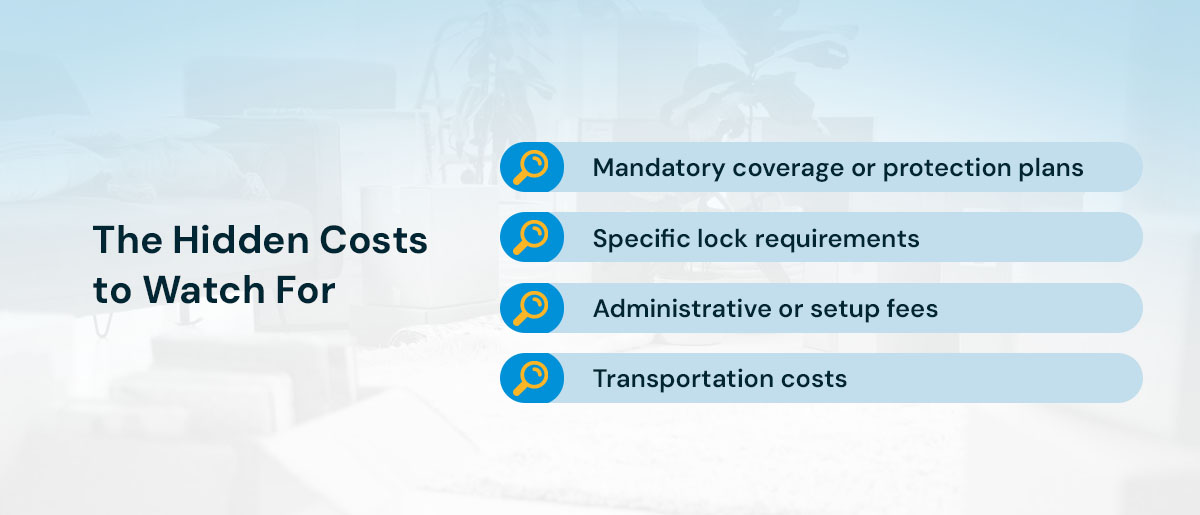
Beyond the base rate, watch for these potential fees:
If you’re looking for cost-effective ways to store belongings during a move, these strategies can significantly reduce your expenses:
Storage-in-transit (SIT) is a service that many professional movers offer. They load and store your belongings in a secure warehouse, then deliver everything when you’re ready. The same team handles your items from start to finish, reducing damage risk and eliminating the hassle of coordinating multiple companies.
While not the most affordable option, the standout advantage is simplicity. Your belongings stay in the moving company’s care the entire time, meaning fewer hands touch your furniture and you don’t need to rent a truck. If packing feels overwhelming, professional packing services can handle the job efficiently.
Storage-in-transit with a professional mover is your most convenient option while maximizing the safety of your belongings.

When you want a moving and storage experience that handles the heavy lifting, Corrigan Moving Systems has you covered. With nearly a century of expertise, we offer a full-service solution that combines professional moving with flexible storage options, so you don’t have to coordinate multiple companies or worry about your belongings changing hands.
Our team provides a free consultation to understand your timeline and needs, then delivers the handiwork and care the Corrigan name is known for. From packing to storage to final delivery, we’re with you every step of the way.
Contact us for your residential move and experience the difference of working with true moving experts.
