

Moving abroad is an exciting opportunity. Of course, the preparation for an international move can be complex, from organizing your belongings to dealing with customs. International shipping costs are often calculated by volume, so downsizing and decluttering are important for sticking to your budget.
Whether you’re moving with your whole family, heading out on a solo adventure or relocating for a new job, this guide will help you sort through your belongings and prepare you for a smoother transition.
Before selling your possessions, it’s important to understand why downsizing is a must before an international move. Ideally, you’d pack up your entire household and ship it overseas with you. The reality is that as you move more items, especially heavier ones, your shipping costs will increase.
Volume: Shipping costs are typically based on how much space you occupy in a container, measured in cubic feet or cubic meters. Even if your items are lightweight, they’ll still drive up the price if they take up more physical space.
Weight: Your items’ weight is less of a factor for shipping, but it’s essential for air freight. Heavier items can be more expensive to move via air freight.
Effectively decluttering your home without feeling overwhelmed is possible — you just need the right strategy. Here’s how to declutter before an international move:
Researching your destination country is a crucial first step to downsizing before an international move.
First, look into their customs regulations for prohibited and restricted items. You can avoid keeping items you’d have to leave behind anyway. Next, check the country’s voltage and plug types to identify electronics that could be difficult or impossible to use. Last, research the floor plans of your new place to understand space constraints and avoid overpacking.
It’s best to plan the decluttering process in advance, ideally two to three months before the move date.
A crucial part of downsizing is keeping only your most essential items. You don’t want to arrive at your new place with items you don’t use. Categorize your belongings into these categories: items you can’t live without, sentimental items, and items you can replace easily. Anything you can replace can usually be donated or given to friends and family.
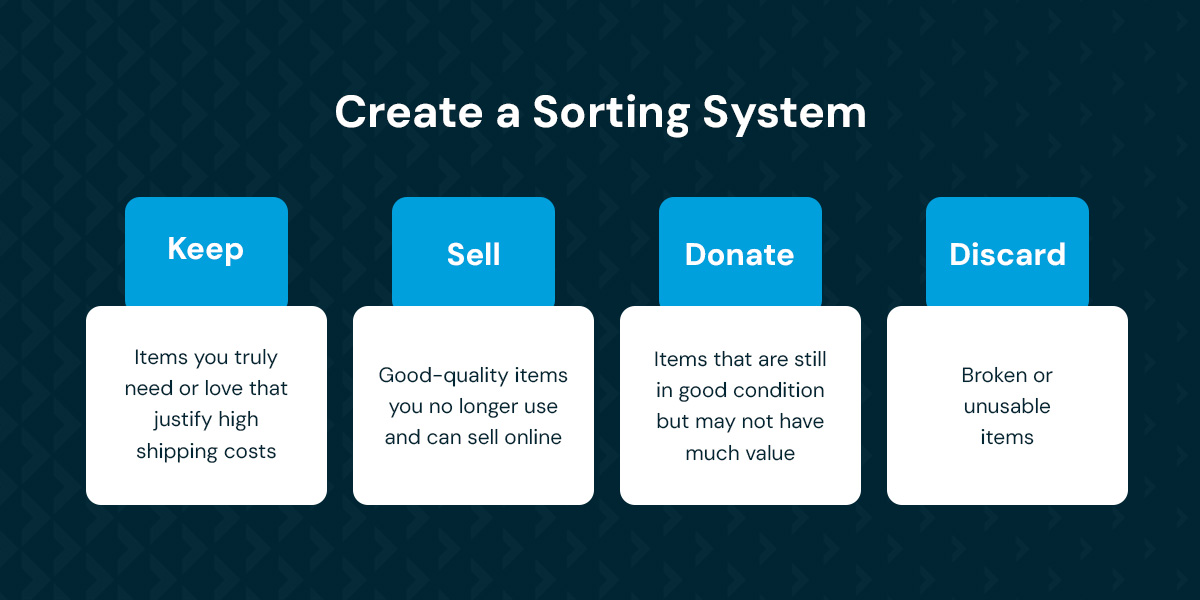
Consider using the four-box method as you declutter. This proven technique can help you make firm decisions. Separate your belongings into four categories to help you decide what to keep and get rid:
Keep: Items you absolutely need or love that justify the high cost of international shipping
Sell: Good-quality items you no longer use and can sell online
Donate: Items that are still in good condition but may not have much value
Discard: Broken or unusable items
Decluttering for an international move involves getting rid of belongings you don’t need to reduce shipping costs and adjust to a new space. Here are some items you can focus on:
If your new home will have different dimensions or furniture styles, consider selling or donating your current pieces. Getting rid of extra-large furniture, such as mattresses or desks, can be a great way to lighten your load and lower overall shipping costs. Unless it’s a high-value heirloom, it’s usually cheaper to sell furniture and buy new at your destination than to pay for container space.
Small appliances like hair dryers, toasters and blenders often won’t work because voltage standards vary by country. While the U.S. typically uses 110-120 volts, many countries in Asia and Europe use 220-240 volts. Your electronics may need a voltage converter or transformer to work in your destination country. It’s sometimes better to sell or donate these items and buy new ones once you settle into your home.
If your wardrobe doesn’t suit the climate of your new destination, consider selling or donating those items. There’s no point in bringing warm sweaters to a tropical country — you’ll only be adding extra weight to your luggage. You should also consider getting rid of any clothes that you no longer wear.
While your media collection may be your pride and joy, it can add to the weight of your load and take up significant space. If you have an extensive collection of books, magazines, vinyls or movies, consider selling them online to make your move lighter.
Moving internationally means you have to follow global safety and customs regulations. While specific rules vary by destination, several categories of items are almost universally prohibited or heavily restricted. These items usually include flammable materials, perishables, plants and particular electronics. Check customs regulations and research what’s not permitted in your destination country so you know what to leave behind.
A strict “keep” list can simplify costs and logistics. Prioritize items that are either essential for legal entry, high-value or provide immediate comfort in your new home.
Personal documents: Make sure you have all your important personal documents in your carry-on bag. These documents include your passport, birth certificate, visa and health records.
High-quality furniture: While furniture usually takes up space, it may be worth keeping if it’s in excellent condition and of high value.
Sentimental items: Keep family heirlooms, photo albums or unique artwork that can’t be replaced.
Clothing: Bring at least two weeks’ worth of clothes suitable for the destination’s climate.
Once you’ve sorted through your belongings and know what you’re taking with you, it’s time to pack. For international moves, proper packing helps you prevent damage and meet shipping regulations. Due to the complexities of customs and international shipping, hiring professional movers to pack your belongings is a smart choice. These pros can take the stress off your shoulders by overseeing every step of your move and safely getting your things from point A to point B.
At Corrigan Moving Systems, we’re here to help make your international move as simple as possible. We deliver expert global relocation solutions and international move services backed by over 100 years of experience. Our team has an in-depth understanding of shipping rules and provides customs compliance support to help simplify the process.
With our global network partners, we can easily coordinate your move to anywhere in the world. Contact us today to start planning your move!